

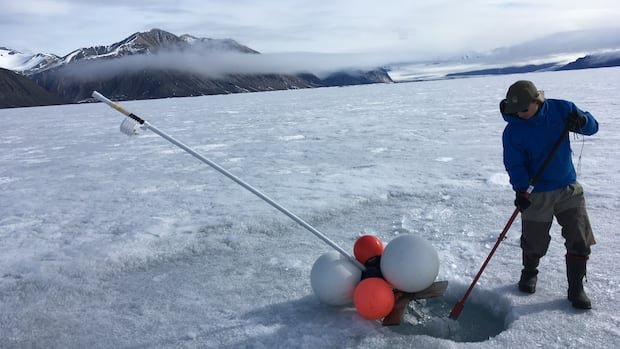

A study by scientists has confirmed the disappearance of Canada’s last remaining epishelf lake, a unique freshwater body floating on saltwater that supported a distinct ecosystem. Jérémie Bonneau, the lead author from Laval University, expressed sadness over the loss of the Milne Fiord epishelf lake on Ellesmere Island in Nunavut, noting it was a singular feature in Canada. The lake’s vanishing underscores the impact of climate change in transforming the Arctic.
The recent study, published in Scientific Reports, provides insights into the process leading to the lake’s demise, describing the event as a significant regime shift marking the end of a 4000-year era. The Milne Ice Shelf collapse in 2020 triggered the lake’s disappearance, as the ice wall that held the lake in place disintegrated, allowing the freshwater to drain into the fiord.
The lake’s unique ecosystem, with distinct freshwater and saltwater communities existing in close proximity, showcased a rare phenomenon. Microbial analysis revealed a diverse range of organisms, including bacteria, eukaryotic microbes, and previously unreported species in the Arctic, thriving in the lake’s layers. The lake also supported an ecosystem beyond its boundaries, as nutrient-rich freshwater from the lake sustained marine life in the channel under the ice shelf.
Following the collapse of the ice shelf, the freshwater rapidly drained from the fiord within two months, leading to the demise of the lake’s inhabitants. The transition from a freshwater lake to a saltwater fiord altered the marine environment, highlighting the loss of a unique ecosystem. While epishelf lakes have disappeared from Canada, similar formations still exist in Greenland and Antarctica, though their future remains uncertain in the face of ongoing environmental changes.