

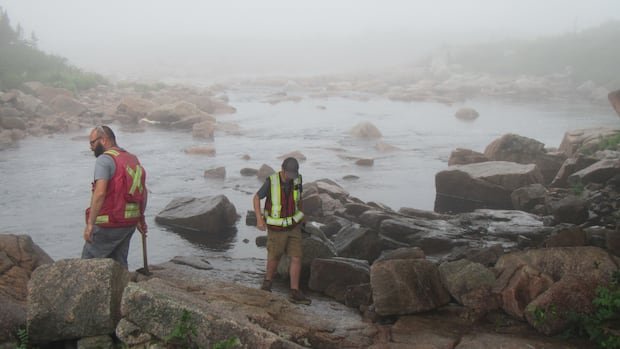

Wildfires in Newfoundland and Labrador are increasingly posing public safety risks and affecting routine operations in rural and remote regions, including essential geoscience activities for the mining industry. These fires can render work areas inaccessible, prompting the redirection of aircraft meant for transporting scientists to assist in wildfire response efforts.
As a result, program directors overseeing scientific initiatives face challenges in planning and scheduling due to the impact of wildfires. Despite these hurdles, the Minister responsible assures that the Geological Survey of Newfoundland and Labrador has managed to progress with its work, even though the actual transportation spending for geophysical surveys in the previous year was $321,800 lower than budgeted, mainly due to decreased helicopter usage caused by wildfire-related disruptions.
Geological survey teams utilize drones for certain field tasks, but critical activities such as sample collection often require helicopter access, particularly in Labrador’s remote areas. Helicopter travel disruptions can arise due to adverse weather conditions like high winds, cloud cover, and fog, as well as the reallocation of resources to support wildfire suppression efforts during peak fire seasons.
Recent collaborative projects, partly funded by the federal government, have focused on data collection in regions like southeastern Labrador and White Bay, targeting rare earth elements. The Geological Survey currently oversees ten active field projects, split between Newfoundland and Labrador, with additional planned aerial surveys utilizing fixed-wing aircraft.
The invaluable work conducted by the Geological Survey plays a pivotal role in driving investment, de-risking projects, shaping land use decisions, and expediting discoveries in the mining sector, according to Amanda McCallum, the executive director of Mining Industry N.L. Despite wildfire disruptions, private exploration spending in the province has reached record highs, projected at $283.3 million for the year, indicating sustained interest and investment in resource development.
Industry players are adapting to wildfire challenges by adjusting field schedules, although project delays are manageable, ensuring ongoing progress. With mining standing as Newfoundland and Labrador’s second-largest GDP contributor, supporting public geoscience initiatives remains crucial for industry growth and economic development.
Although the wildfire risk level across the province remains low, some active fires persist in central and northern Labrador. While the current year has witnessed fewer fires compared to the previous year, the total area burned has been larger. The mining sector, with 11 operational mines and approximately 8,920 direct employees as of 2025, continues to drive economic activity in the region.