

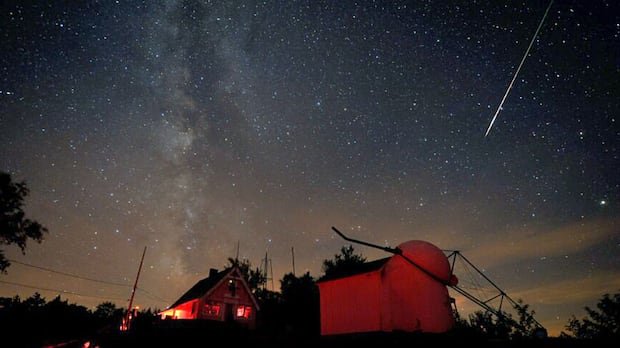

In August, the Perseids meteor shower, known for its brightness and abundance of meteors, will coincide with a partial solar eclipse. The peak night for viewing the Perseids is on Aug. 12-13, which aligns with a new moon, providing optimal conditions for spotting meteors.
Peter Brown, a professor at Western University in London, Ont., expects Earth-grazers, bright and fast meteors that re-enter space after entering Earth’s atmosphere, to be particularly active this year. Viewing is recommended to start around 10 p.m. to catch these spectacular meteors.
The Perseids are expected to peak around midnight Eastern Daylight Time, with a potential of up to 120 meteors per hour. However, actual visibility may vary depending on viewing conditions.
To maximize meteor sightings, clear skies are essential. It is advised to minimize light pollution by finding a dark location and allowing your eyes to adjust to the darkness. The radiant point of the meteors is in the constellation Perseus, though they can be seen streaking across the entire sky.
Additionally, the southern delta Aquariids, alpha Capricornids, and kappa Cygnids meteor showers are active, offering opportunities to witness shooting stars. Along with these organized showers, sporadic meteors will also be visible during this “meteor Christmas” time.
As for the partial solar eclipse on Aug. 12, while the total eclipse will not be visible in Canada, observers can witness the moon partially obscuring the sun. Care must be taken when viewing the eclipse, using approved solar eclipse glasses to avoid eye damage.
Astronomers suggest taking the opportunity to witness the celestial dance of the Earth, moon, and sun during the solar eclipse, a humbling experience showcasing the beauty of nature in motion.