


On a dim Saturday evening in late August, the Chaleur Lightning hockey squad had just wrapped up an exhibition match against the Miramichi Timberwolves and were on the team bus heading back to Bathurst.
Assistant coach Alex Ouellet recalled a moment when the driver suddenly gasped. “It happened within the first five minutes of the journey,” Ouellet recounted. “I glanced up and saw a figure ahead of us, followed immediately by a loud bang.”
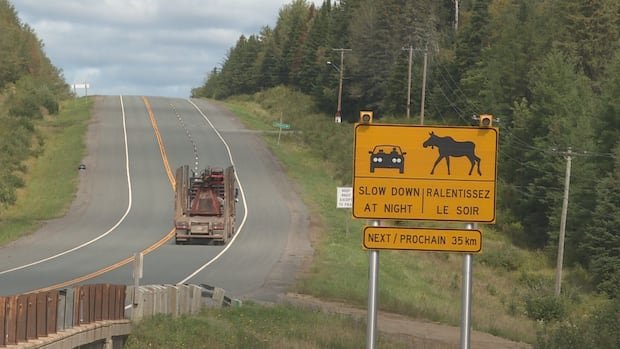
The team bus had a collision with a moose on the highway. Luckily, Ouellet mentioned that everyone on board, including players and coaches, emerged unscathed, except for the driver who sustained minor scratches.
Like many residents of New Brunswick who have encountered or narrowly avoided large wildlife, Ouellet and the team will always remember the incident. “Every time I travel those roads, especially in the evening and at night, I will definitely be thinking about it,” he shared.
Coincidentally, during that same week, the province unveiled plans to construct two new wildlife crossings on that specific highway segment.
The province employs various strategies to deter moose from entering roadways, such as wildlife fencing and crossings or tunnels. Transportation Minister Chuck Chiasson stated that the placement of these measures is determined by collision data provided by law enforcement to identify high-risk areas.
Presently, both sides of 331 kilometers of New Brunswick highways are protected by wildlife fencing. However, Chiasson highlighted the need to balance fencing with allowing wildlife to move freely and find food without disruption.
New Brunswick currently features 82 wildlife crossings, including concrete tunnels beneath highways. The recent installation of two tunnels on Route 8 between Miramichi and Bathurst boasts dimensions exceeding four meters in height and width, constructed from 11 pre-fabricated concrete sections.
According to Chiasson, the tunnels are spacious enough for a tractor-trailer to pass through. The effectiveness of these tunnels was studied over 15 years ago when they were first introduced on Route 7 between Saint John and Fredericton, as wildlife quickly adapted to using them.
Wildlife ecologist Graham Forbes noted that the tunnels need to be easily accessible and intuitive for animals to navigate. He explained how fencing guides animals towards the underpasses, encouraging them to use the safe passage.
Forbes observed that various animals, not just large mammals, utilize the tunnels. Despite the tunnels’ presence, the Department of Transportation has not observed a significant decline in collisions, with the highest numbers recorded in 2024.
Ouellet expressed optimism about the potential addition of more fencing in the area. Although he acknowledged that preventing all collisions may be unattainable, he emphasized the importance of implementing preventive measures to enhance road safety.