

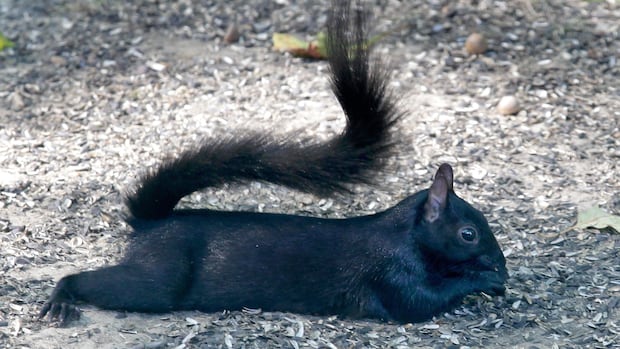

During his initial summer at McGill University, Francis Quang-Hai Dinh spent his time cycling around, in pursuit of squirrels in various parks across the Montreal area.
Dinh pedalled to nearly 200 parks—from Mirabel to Saint-Bruno—documenting and observing over 800 grey and black squirrels.
What began as an undergraduate assignment evolved into a personal endeavor aimed at exploring how the city’s configuration and meandering waterways influence evolutionary processes.
“I developed a fondness for them after spending ample time watching them and contemplating their existence,” Dinh remarked. “People often overlook squirrels, viewing them merely as nuisances, but they are indeed part of the wildlife.”
Without access to a car and limited public transport in suburban regions, Dinh depended on his bicycle to reach distant locations, making him the only known researcher to physically survey squirrels from park to park throughout the area.
Reasons for the prevalence of black squirrels in northern regions
On average, Dinh discovered that approximately 12 percent of the squirrels in Montreal are black. However, as he ventured further north, the proportion of black squirrels increased.
In regions just north of Laval, he noted that up to 40 percent of the squirrels were black—a term that refers to various darker fur patterns that differ from the typical grey coat.
On Laval Island, around 20 percent were black, while on Montreal Island, the figure was roughly 15 percent. In contrast, the percentage on the south shore of Montreal fell to just two or three percent, Dinh explained, as he now pursues studies in integrative biology at the University of Illinois Urbana-Champaign.
The research identified three primary factors contributing to this phenomenon, with temperature being the most significant. The cooler climate in northern areas correlates with a higher prevalence of black squirrels.
“Their black fur absorbs heat better than grey fur,” he noted.
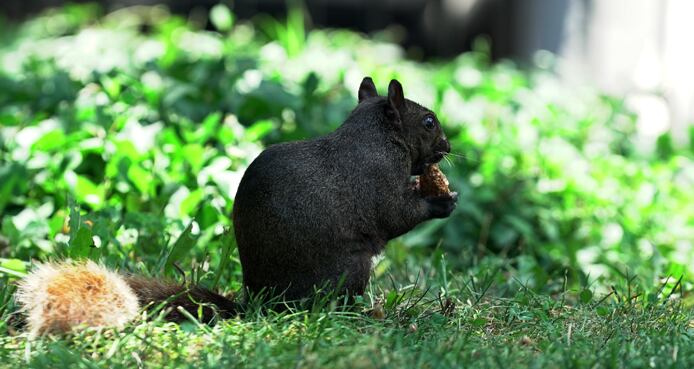
It is believed that black squirrels, which were originally brought from Canada to Washington in 1902, now make up about half of the city’s squirrel population and serve as a tourist attraction. (Jason Lowther/CBC)
Additionally, forest cover plays a role: a denser tree canopy offers a darker environment where black squirrels can blend in more effectively.
Squirrels as a model for evolutionary change
The lead author of the study, Allison Roth, an assistant professor at the University of Missouri and former postdoctoral fellow at McGill, mentioned that the research focuses less on the squirrels themselves and more on them serving as a model to examine how urban settings instigate evolutionary shifts.
Roth pointed out that cities are not homogeneous. Their varied neighborhoods, different levels of tree cover, and unique boundaries—such as Montreal’s waterways—generate fine-scale environmental differences that can result in distinct genetic and physical adaptations within the same animal group.
“One significant aspect of Montreal not often found in many other North American cities is its segmentation by the St. Lawrence River and its tributaries,” Roth explained.
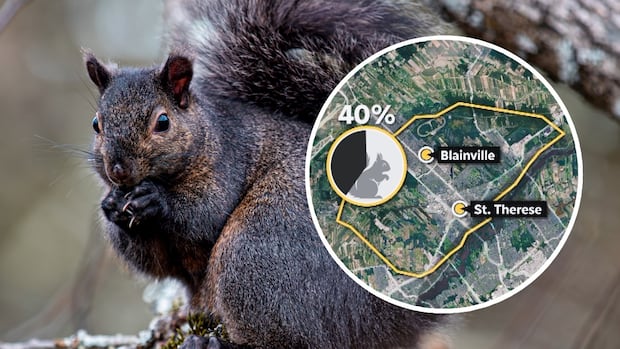
A recent study from McGill revealed that eastern grey squirrels in the city exhibit variations in coat colour based on their neighborhood, influenced by local environmental factors such as temperature and tree cover.
“This creates distinct little islands, and we may observe different patterns of squirrel melanism based on whether these squirrels can traverse rivers or if they are potentially isolated on these land masses,” she added.
All of this is crucial for comprehending how evolution might transpire, she clarified.
Urban areas are just one piece of the larger picture
The research, Fine-scale spatial variation in eastern grey squirrel melanism across a complex urban landscape, is available online.
Unlike most earlier studies that compared urban animals to those in the countryside as a whole, this study focused on wildlife changes at a neighborhood level.
While researchers previously believed that human development was the primary driver of these changes, the findings indicate that urban areas are merely a part of a larger puzzle. Urban expansion alters local temperatures and reduces tree cover, while waterways serve as natural barriers.
The study concludes that “urbanization does not directly predict melanism once local vegetation structure and winter microclimate are considered, but rather influences melanism indirectly through these environmental mediators.”
This research is part of a special feature by five ecology journals that examines how researchers utilize data and collaboration to address significant ecological inquiries.
As for Dinh, he mentioned that his perspective on wildlife has shifted significantly.
“We tend to view city life and nature as completely distinct entities. Yet the reality is that wildlife persists and adapts, regardless of the changes we impose,” he stated.