

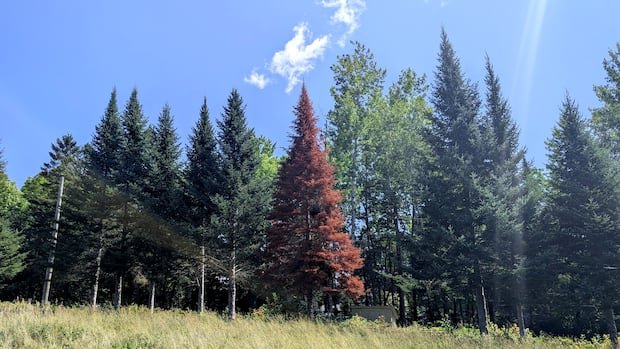

Balsam fir trees in New Brunswick are exhibiting a concerning trend of turning red and perishing due to the impact of last year’s severe drought. Prof. Anthony Taylor, a forestry researcher at the University of New Brunswick, has witnessed firsthand the distressing sight of these iconic evergreen trees, commonly used as Christmas trees, gradually changing color, drying out, and succumbing to the harsh conditions.
According to Taylor, the current scenario aligns with past observations following periods of hot and dry summers. He emphasized that the warm and dry climate adversely affects the growth capacity of balsam fir trees. Taylor, who has been studying the influence of climate change on New Brunswick’s forests for an extended period, highlighted similar instances of balsam fir die-offs occurring after exceptionally hot and dry summers in 1986 and 2018.
The impact of drought conditions triggers an early halt to the photosynthesis process in the trees, hindering their growth potential and energy production. This disruption in energy storage compromises the trees’ ability to sustain essential metabolic functions and produce defense mechanisms, ultimately rendering them vulnerable to stressors like insects or pathogens, increasing the likelihood of mortality.
The shallow root system of balsam firs further exacerbates their struggle to access water during dry spells. Woodlot owner Peter McKeil has observed the distressing effects on his property, with trees displaying red discoloration from the lower branches upwards. The ongoing die-off has already claimed around 100 trees on his land, prompting adjustments in harvesting practices to salvage remaining fir trees before they meet a similar fate.
Expressing concerns about the future of balsam firs in the face of escalating climate change impacts, McKeil emphasized the necessity for adaptive measures to ensure the survival of the species, particularly in southern New Brunswick. Taylor echoed these sentiments, viewing the current situation as a tangible manifestation of climate change’s adverse effects on the provincial tree.
As the red-hued trees serve as a poignant reminder of the environmental challenges posed by a changing climate, Taylor emphasized the urgent need for concerted climate action to mitigate the escalating threats faced by New Brunswick’s iconic balsam firs. He emphasized the importance of transitioning away from fossil fuel dependence and implementing sustainable forest management practices to address the underlying issues contributing to the tree die-offs.