

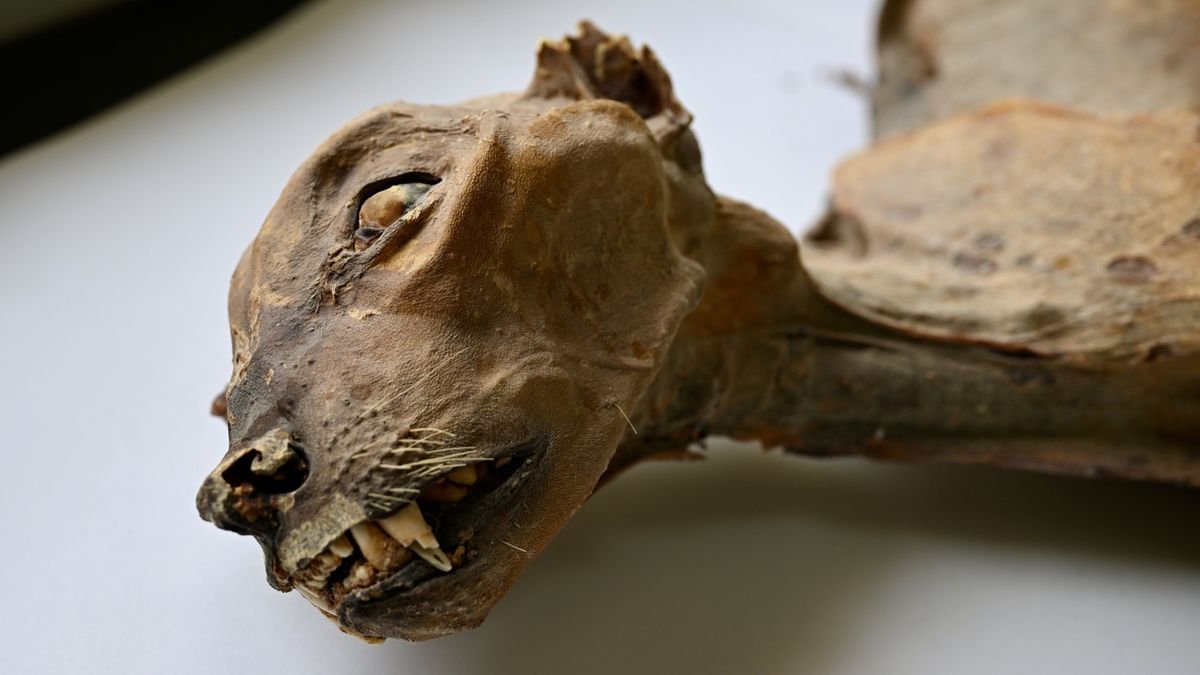

A surprising find revealed ancient cheetah remains dating back as far as 1,800 years in a cave. The well-preserved mummified cheetahs, ranging from 130 to over 1,800 years old, were unearthed by researchers in Saudi Arabia near the city of Arar. Alongside seven mummies, the site also yielded the bones of 54 other cheetahs. Images of the preserved creatures exhibit cloudy eyes and shrunken limbs, resembling desiccated husks. Speculation suggests the site could have been a denning area where cheetah mothers gave birth and cared for their offspring.
Mummification is a process that halts the decomposition of deceased bodies. While Egypt is renowned for its mummies, natural mummification can occur in various environments such as glacier ice, desert sands, and bog sludge.
Joan Madurell-Malapeira from the University of Florence in Italy, not directly involved in the discovery, expressed astonishment, stating, “It’s something that I’ve never seen before.”
In a rare occurrence, scientists have also found mummified remains of other large felines, including a saber-toothed cat cub in Russia. The exceptional preservation of large mammals like cheetahs requires the right conditions to prevent scavengers like birds and hyenas from consuming the carcasses.
Once prevalent across much of Africa and parts of Asia, cheetahs now occupy only nine percent of their former range and have not been sighted in the Arabian Peninsula for years, likely due to habitat destruction, unregulated hunting, and food scarcity.
For the first time in naturally mummified big cats, researchers were able to analyze the cheetahs’ genes, discovering that the remains closely resemble modern-day cheetahs from Asia and northwest Africa. This genetic information could aid in future endeavors to reintroduce these big cats to areas they once inhabited.
Separately, archaeologists have identified remnants of a Roman industrial center close to the current Nissan car plant site on the banks of the River Wear. The excavation at Offerton near Sunderland unveiled over 800 whetstones for blade sharpening and 11 stone anchors. Analysis by Durham University archaeologists confirmed the site’s Roman-era origins.
Volunteers from the Vedra Hylton Community Association made the discovery, highlighting the historical industrial significance of northeastern England within Roman Britain, predating later industries like coalmining, shipbuilding, and car manufacturing.