

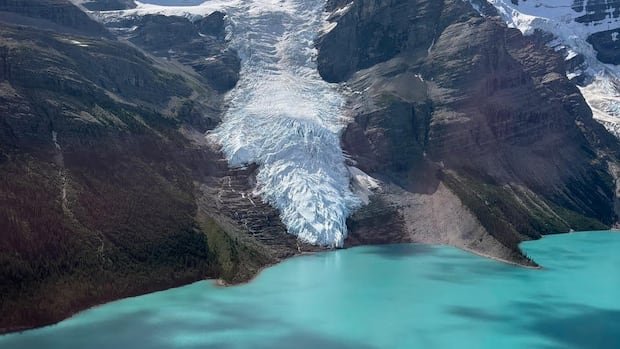

Mount Robson’s Berg Glacier in British Columbia is undergoing significant changes, with researchers observing that the glacier has retreated to the point where it no longer reaches Berg Lake. Joseph Shea, a geography associate professor at the University of Northern British Columbia (UNBC), made this observation during a recent field project on the mountain. The Berg Glacier, situated on the north face of Mount Robson, which is the highest peak in the Canadian Rockies near the Alberta border, used to extend all the way to Berg Lake, where ice chunks would break off into the water, forming icebergs.
Over the past few years, there have been noticeable alterations in the Berg Lake glacier, as highlighted by UNBC researcher Brian Menounos in collaboration with B.C. Parks. The Berg Lake Trail, spanning 23 kilometers and renowned for its breathtaking scenery, has been a popular destination for outdoor enthusiasts. Despite the glacier no longer connecting to the lake, Shea believes this change will not impact the lake’s water level significantly, but it may reduce the number of icebergs entering Berg Lake.
On a broader scale, Menounos’ research on glacier melt has revealed a 22% loss in the surface area of glaciers in Western Canada and Switzerland between 1985 and 2021. Additionally, occurrences like the severe damage caused to parts of the Berg Lake Trail due to melting snow and ice during a record-breaking heat wave in 2021 have underscored the effects of climate change in the area.
Efforts are underway to mitigate the impact of these changes, including the installation of real-time weather stations to monitor weather conditions in Mount Robson Provincial Park. These stations will provide crucial data for park management, aiding in wildfire forecasting, avalanche prediction, and overall safety for park visitors. B.C. Parks aims to have this real-time weather data available by late 2026, enabling proactive decision-making and enhancing visitor safety within the park.