

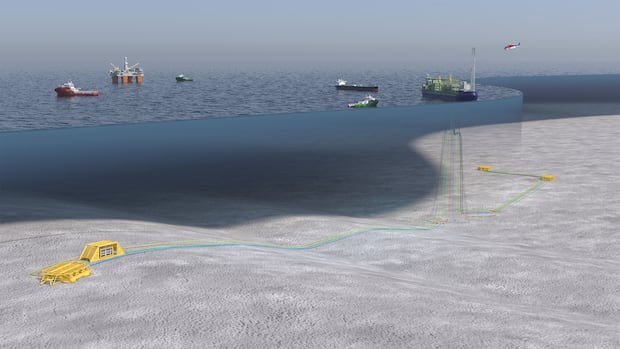

Researchers in Australia have developed what they claim to be the world’s first public tool designed to assess the climate impact of fossil-fuel projects, using a Canadian offshore oil initiative as a case study.
The newly created Carbon Impacts Tracer can project how proposed mining operations, offshore oil rigs, and other energy-related ventures will contribute to global warming, glacial melting, and potential human fatalities.
“We are now able to connect the emissions linked to specific fossil-fuel initiatives to the warming they cause on Earth, and then directly relate that to particular consequences of that warming,” stated Sarah Perkins-Kirkpatrick, a climate science professor at the Australian National University, during a virtual press briefing on Monday.
This online tool utilizes anticipated carbon dioxide emission figures, frequently sourced from the environmental impact assessments of project proponents, to calculate the effect on global temperature increases.
It further employs peer-reviewed research to determine the tangible consequences of that temperature rise, including coral reef degradation, declines in food production, and job losses.
The tool was launched on Monday, featuring case analyses of five Australian projects, one from the U.K., and another concerning the proposed Bay du Nord offshore oil project, which, if realized, would mark Canada’s inaugural deepwater oil initiative, situated approximately 500 kilometers east of St. John’s.
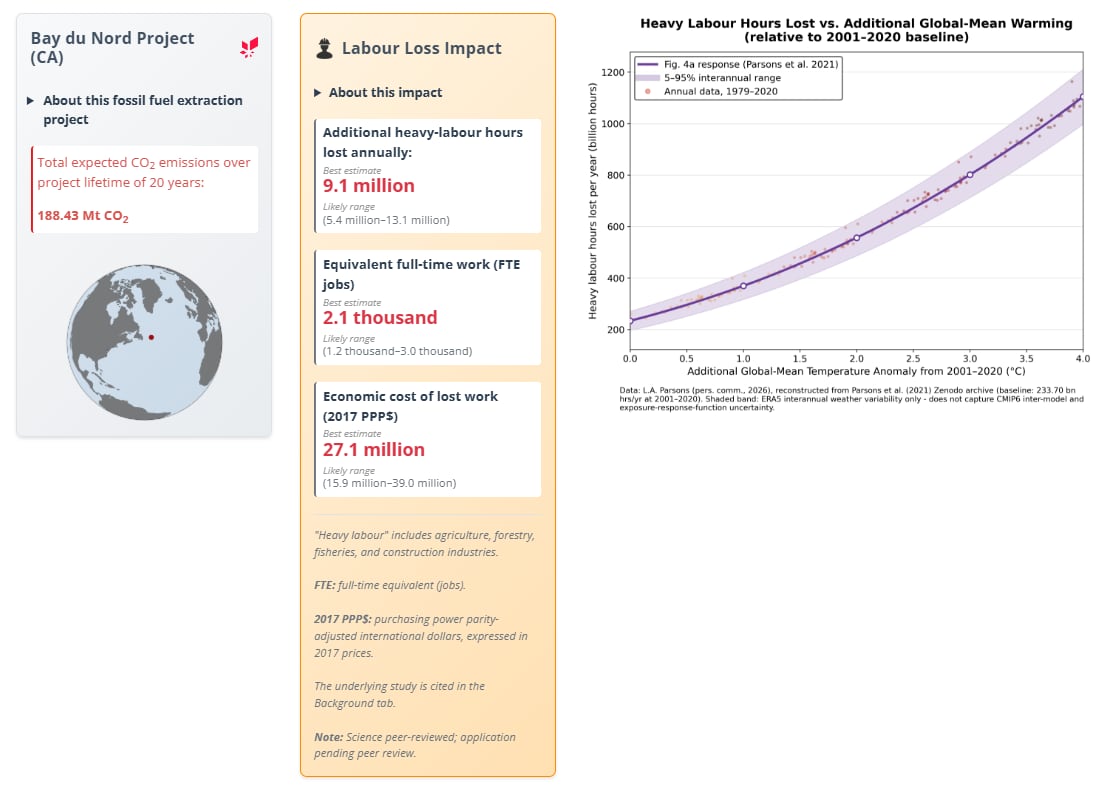
The Carbon Impacts Tracer site forecasts the potential effects of projects like Bay du Nord on aspects such as labor, agriculture, and glacial retreat. (Carbon Impacts Tracer)
Led by the Norwegian energy company Equinor, the Bay du Nord project is projected to extract more than 430 million barrels of oil reserves. According to the tool, CO2 emissions from this project could reach 188 megatonnes over two decades, contributing an additional 0.00008 degrees Celsius to global temperatures.
Moreover, the tool indicates that such emissions would put over 111,000 additional individuals at risk of extreme heat and could result in 25 more heat-related fatalities in Europe alone.
The tracer suggests that Bay du Nord could lead to the loss of 4.6 square kilometers of glaciers, causing a sea level rise of 0.025 millimeters. Additionally, it estimates that about 2,100 jobs could be lost due to pollution from the project, pushing approximately 9,800 people into extreme poverty.
As of Monday, Equinor had not responded to a request for comment.
Joel Finnis, a climatologist at Memorial University in Newfoundland and Labrador, although not involved in the tracer initiative, is part of a local group assessing the oil and gas sector’s impact in the province. He remarked that the tracer consolidates findings from various studies, making it more accessible for the general public.

Climatologist Joel Finnis believes the Bay du Nord project could have significant environmental repercussions. (Darryl Murphy/CBC)
“It fundamentally undermines the arguments that are frequently made to promote new oil production and expansion,” he said in an interview. “And [it] provides a clear reminder that even what might be perceived as a minor project will result in significant loss of life for many people. It will also incur substantial financial costs and inflict considerable environmental harm.”
Maria Nawaz, the director of the climate change accountability initiative at the Australian Human Rights Institute of the University of New South Wales, informed reporters that historically, linking a fossil fuel project to its actual impacts has been challenging. Many proponents maintain that their specific projects represent only a “drop in the ocean” regarding emissions.
-
Final decision on Bay du Nord set for early 2027 as estimated oil reserves grow
-
Public gives mixed feedback on Bay du Nord as regulator prepares recommendations
She expressed hope that the tracer will be utilized by governments, regulators, and the public as new projects are proposed within their communities. She anticipates it will bolster climate-related legal actions aimed at holding governments and corporations accountable for their emissions.
“Specific fossil fuel initiatives can now be directly connected to additional warming and associated, measurable human and ecological damages… This implies that the defense of being a `drop in the ocean’, which relies on the assertion that the harm is negligible or unmeasurable, can no longer be valid.”
Nawaz noted that she envisions insurers using the tool to assess project risks, while economists might use it to forecast economic repercussions.
The site focuses solely on estimating the impacts of proposed projects, excluding existing oil wells or mines, and researchers plan to include additional proposed developments as new data becomes accessible.
Download our free CBC News app to sign up for push alerts for CBC Newfoundland and Labrador. Sign up for our daily headlines newsletter here. Click here to visit our landing page.