

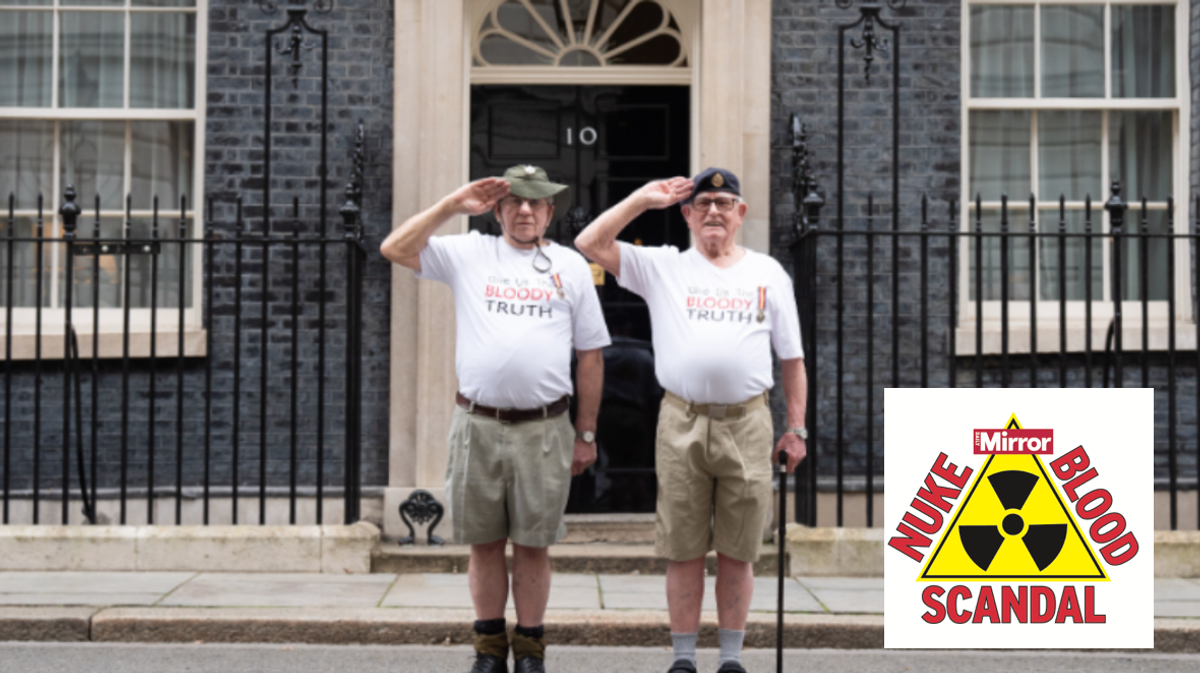

A government study investigating the cancer rates of veterans who participated in Cold War nuclear bomb tests purposely excluded evidence showing over 1,000 troops had been exposed to radiation. The finalized report dismissed any link between their deaths and the weapon trials, attributing any cancers to chance.
Decades later, a revised version of the research revealed a significant association between serving at nuclear test sites and later mortality, but could not definitively establish a direct connection between cancers and radiation exposure. It has now come to light that a substantial number of documented radiation doses were initially removed from the study.
Advocates are urging the Ministry of Defence to cease relying on the discredited study, which underwent revisions to its conclusions by officials. They plan to address this issue in an upcoming meeting with Prime Minister Keir Starmer early in the New Year.
According to Alan Owen of the group LABRATS, veterans had always suspected the study’s lack of credibility, and the recent findings confirm their suspicions. They aim to press the Prime Minister to acknowledge the truth and honor the victims of these human radiation experiments.
The discovery stems from an analysis of dose records known as “the Blue Books,” maintained by the Atomic Weapons Establishment and previously classified as state secrets. The Mirror obtained a copy after a prolonged Freedom of Information battle, revealing that in 1982, 14,290 servicemen partook in trials in Australia and the Pacific, with 6,053 receiving recorded radiation doses.
Subsequently, during a government-led study on cancer and mortality in 1985, 1,031 individuals with recorded radiation doses were excluded from the analysis. This led to an increase in the total number of veterans examined for mortality but a decrease in the number of exposed individuals.
Former RAF technician John Folkes, who participated in atomic cloud sampling missions in 1956, experienced similar discrepancies in recorded doses. Despite having his radiation levels monitored, a significant portion of the data was excluded from the final report.
The Ministry of Defence defended the study, citing rigorous research methods and the exclusion of troops due to untraceable medical records. They clarified that the Blue Books served as a starting point for participant identification and that extensive efforts were made to verify and rectify any discrepancies in the data.