

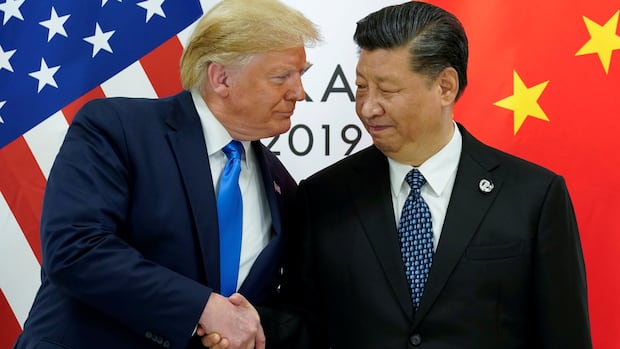

This week, U.S. President Donald Trump warmly welcomed Xi Jinping, the Chinese president, calling him a “great leader” while seeking to expand or extend an agreement made last year to avoid certain tariffs and establish a trade truce.
Trump has previously claimed to have secured “fantastic trade deals” with Beijing and has recently hinted at the possibility of inviting Chinese automobile manufacturers to establish production facilities in the United States.
“If China wished to come and establish a factory to produce their vehicles here, I would be fine with that,” he stated during an appearance on Fox News’ The Ingraham Angle. Reports indicate that Trump managed to secure that extension with China late Wednesday.
However, Trump and several members of his administration have consistently criticized Prime Minister Mark Carney for negotiating a significantly smaller trade agreement — which in January allowed for the import of 49,000 Chinese electric vehicles with a lowered tariff rate of 6.1 percent (down from 100 percent), while China decreased tariffs on Canadian goods such as canola, peas, lobsters, and crabs.
“They will look back on this decision and undoubtedly regret it,” remarked U.S. Transportation Secretary Sean Duffy regarding the electric vehicles at that time.
Commerce Secretary Howard Lutnick adopted a more aggressive stance, accusing Canada of abandoning its relationship with the U.S.
“We are a $30 trillion economy, the consumer of the world. Carney has an issue with us and then gets on a plane to China? Does he believe the Chinese economy will buy his products?” he expressed to Bloomberg.
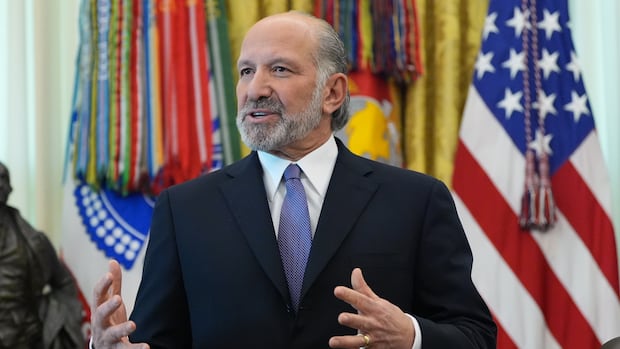
U.S. Commerce Secretary Howard Lutnick criticized Canada’s trade approach on Friday, stating that Prime Minister Mark Carney ‘has a problem with us’ and ridiculing Carney’s recent trade expedition to China. Semafor editor-in-chief Ben Smith, who posed the question about Canadian trade to Lutnick, commented on Power & Politics.
Jia Wang, a senior fellow at the China Institute at the University of Alberta, points out that this situation underscores the U.S. tendency to demand one standard from its trading partners while applying a different standard to itself.
“The hypocrisy in the U.S. approach towards its trading partners is evident,” she stated.
Canada’s trade with China began to gain momentum in 2025 as businesses aimed to diversify in response to U.S. tariffs. Concurrently, American importers reduced their purchases of Chinese goods.
Nevertheless, Canada would need to more than triple its trade with China to match the volume of imports the U.S. continues to bring in annually.
In 2025, the U.S. imported over $434 billion in Chinese products, while Canada imported merely $90 billion from China.
Yet, Senator Rick Scott, a Republican from Florida and Trump supporter, emphasized what he perceives as the dangers for Canada in enhancing trade with China in an extensive essay shared on X.
“Opting for Communist China over the U.S. as a trading partner isn’t merely a bad idea — it’s a trap,” he wrote in early September.
As many commentators noted, Florida imports more goods from China than from Canada, ranking as one of four U.S. states that consider China their primary source of imports (alongside California, South Carolina, and Tennessee).
However, Wang argues that such nuances are often overlooked in Trump’s binary worldview where everything revolves around power dynamics.
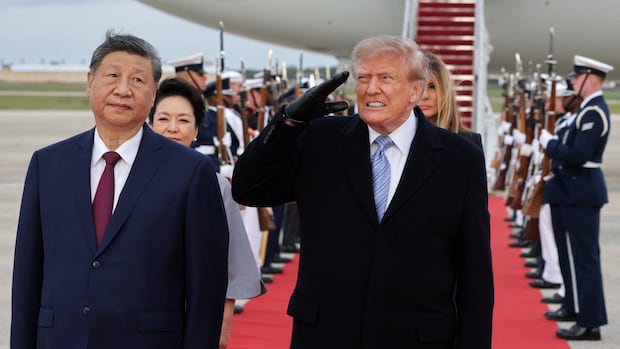
Chinese President Xi Jinping was greeted with a rare planeside welcome from U.S. President Donald Trump upon his arrival in Washington on Wednesday. Jinping’s state visit occurs amid heightened tensions between the two geopolitical rivals regarding trade, artificial intelligence, Trump’s conflict with Iran, and China’s ambitions concerning Taiwan.
Trump “is eager to welcome Chinese investment, to deepen economic ties with China, and to further solidify his relationship with Xi while being highly critical and harsh toward Canada,” she remarked.
Mark Manger, a professor at the Munk School of Global Affairs & Public Policy at the University of Toronto, concurs that there is an aspect of hypocrisy within U.S. policy that seeks to negotiate with China while dissuading nations like Canada from pursuing similar avenues.
-
Analysis
Trade ‘war’ or not, are Canada and the United States now dug in?
-
Canada’s exports to China up 30% in first half of 2026
-
Here’s what you need to know about the Canada-China deal on EVs and canola
“However, we must approach everything the U.S. president states with skepticism. What significant deals is he actually making with China? I don’t observe anything substantial,” he commented in an interview.
Manger highlights that China remains the largest exporter globally and is rapidly closing in on the U.S. in the field of artificial intelligence.
Moreover, he asserts, China understands that it can outlast Trump.
“The Chinese are playing a long game,” Manger stated.
Both Manger and Wang emphasize that Canada must also adopt a long-term perspective.
“We must engage with both economies. We cannot simply wish them away,” Wang remarked.
Additionally, she notes, managing relationships with both economies will necessitate strong leadership, strategic foresight, and thoughtful decision-making as smaller nations like Canada navigate the challenges posed by the two largest economies in the world.
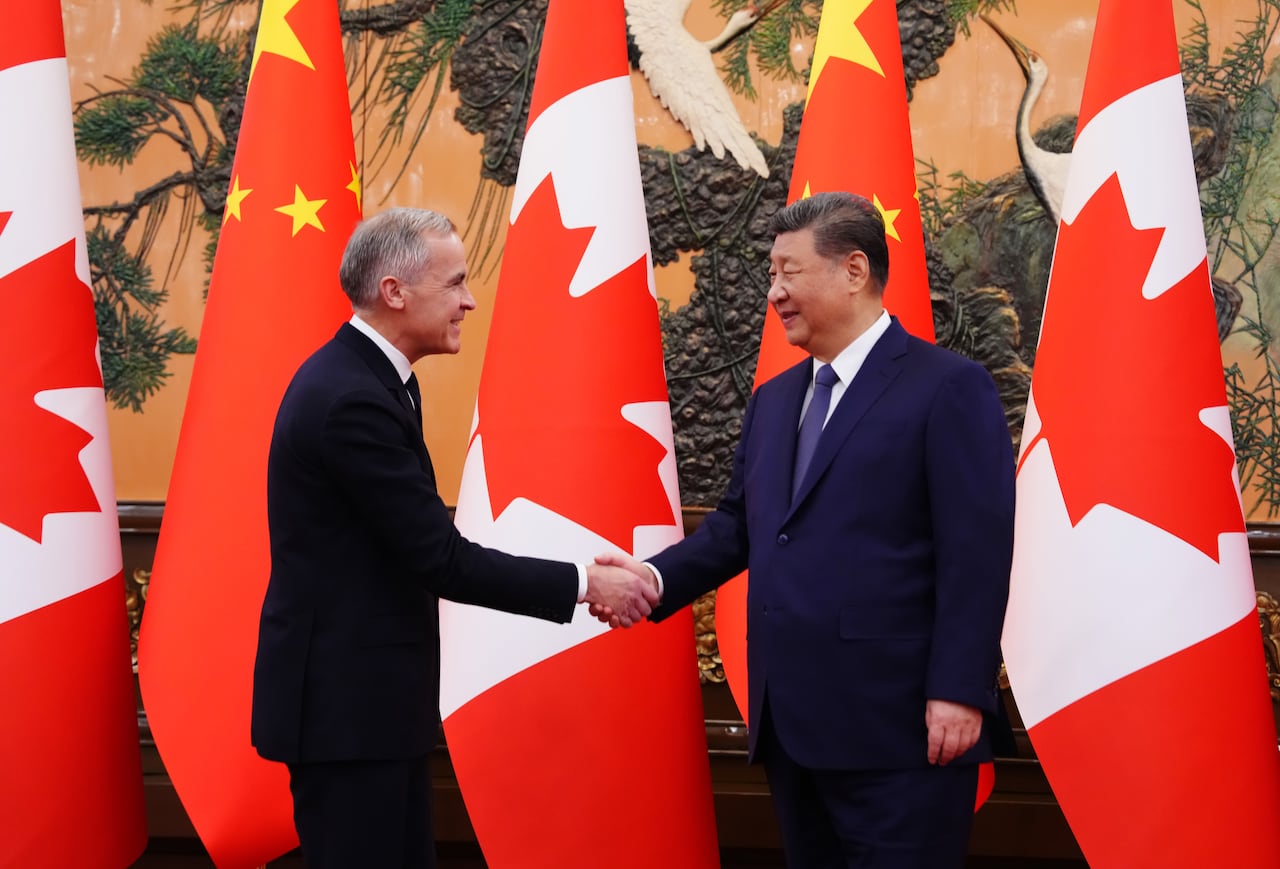
Prime Minister Mark Carney meets Xi at the Great Hall of the People in Beijing, on Jan. 16. (Sean Kilpatrick/The Canadian Press)
Tag: rewrite-pending