

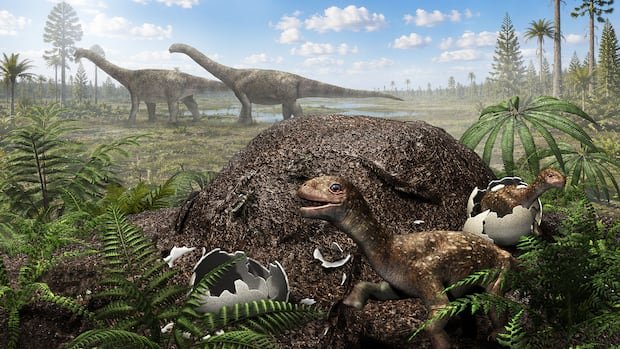

Fossil eggshells thought to belong to some of the largest dinosaurs ever discovered have been unearthed in a cooler climate far from the equator. Despite their size, the colossal titanosaurs couldn’t rely on brooding to keep their volleyball-sized eggs warm, as they were too large, leading to a humorous analogy of the nest becoming “one big omelette.”
A recent study led by University of Tsukuba paleontologist Kohei Tanaka, along with researchers from Japan and Argentina, examined the microscopic details of the eggshells. Through their analysis of the eggshell pores, they concluded that titanosaurs likely employed a similar incubation method to modern crocodiles by burying their eggs in warm piles of decaying vegetation to maintain the necessary warmth for hatching.
Titanosaurs were massive herbivorous dinosaurs with long necks and tails that walked on all fours, weighing up to 75 tonnes, equivalent to about half the weight of a blue whale. These creatures, known as the giants of the dinosaur world, roamed the Earth during the Late Cretaceous period.
The discovery of volleyball-sized fossil eggs associated with titanosaurs, known as Fusioolithus, was initially made in warmer regions before fragments of these eggshells were later found in the Chorrillo Formation in southern Argentina. This finding, dating back 72 to 66 million years ago, indicates a shift in the understanding of titanosaur nesting habits.
The Chorrillo Formation, situated at a latitude comparable to Red Deer, Alta., but with a climate resembling present-day New York City, provided paleontologists with a glimpse into the ancient ecosystem where titanosaurs like Nullotitan glaciaris and other dinosaurs coexisted with a variety of reptiles, mammals, and insects.
Dinosaurs faced the challenge of keeping their eggs warm for extended periods to ensure successful hatching. While smaller dinosaurs could brood their eggs for warmth, titanosaurs had to explore alternative methods due to their enormous size. The study sheds light on the adaptability of dinosaurs, showcasing how even the largest species found innovative ways to thrive in different environments.
Research continues to uncover new insights into dinosaur nesting behaviors, with the hope of unraveling the mysteries surrounding the remarkable diversity and success of these ancient creatures.