

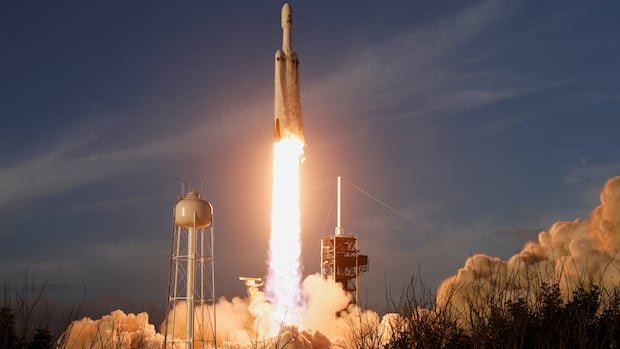

NASA embarks on a groundbreaking mission to explore fundamental questions in astrophysics and cosmology by launching the Nancy Grace Roman Space Telescope, a revamped spy satellite aimed at capturing expansive views of the universe. The approximately $4 billion project was lifted off from NASA’s Kennedy Space Center in Cape Canaveral, Fla., on a SpaceX Falcon Heavy rocket under clear skies just after sunrise. The telescope’s primary objective is to delve into cosmic mysteries such as dark energy, dark matter, gravitational studies on a large scale, and the quest for exoplanets, planets outside our solar system.
The Roman Space Telescope, named after NASA’s inaugural chief astronomer, will position itself in an orbit beyond the moon to scrutinize celestial phenomena. Originally conceived as part of a spy satellite initiative by the National Reconnaissance Office, the project faced budgetary challenges and was later transferred to NASA in 2012 for cosmic exploration.
Scheduled for a five-year mission, with a potential for an additional five years based on fuel reserves, the telescope will journey towards Lagrange Point 2, around 1.6 million kilometers from Earth. Following a 90-day commissioning period, mission scientists will prepare for scientific operations, with the first batch of high-resolution images expected to be transmitted before the winter holidays, as stated by Roman telescope project manager, Jackie Townsend.
Building on the accomplishments of other space observatories like the James Webb Space Telescope (launched in 2021) and the Hubble Space Telescope (launched in 1990), NASA anticipates that the Roman telescope will gain widespread recognition for its contributions to scientific exploration. The telescope is equipped with capabilities akin to the Hubble in sensitivity and vision sharpness but with the ability to survey the cosmos at a quicker pace. The Roman telescope can scan our entire Milky Way galaxy in a month, a feat that would take the Hubble a century to accomplish.
The telescope’s launch comes after congressional efforts to preserve its funding, which faced opposition from the previous administration. Despite attempts to cancel or reduce its funding, Congress ensured the project’s continuation, resulting in an accelerated launch timeline, nine months ahead of schedule.
Differentiating itself from the Webb telescope’s deep-space observations, the Roman telescope will offer panoramic views of the universe, aiding in the comprehensive mapping of dark energy and dark matter. By scrutinizing over two billion galaxies during its main survey, Roman aims to enhance understanding of these enigmatic cosmic components. Additionally, the telescope will conduct an extensive hunt for exoplanets, potentially unveiling thousands of new planets and providing the first statistical overview of planetary systems resembling our own.