

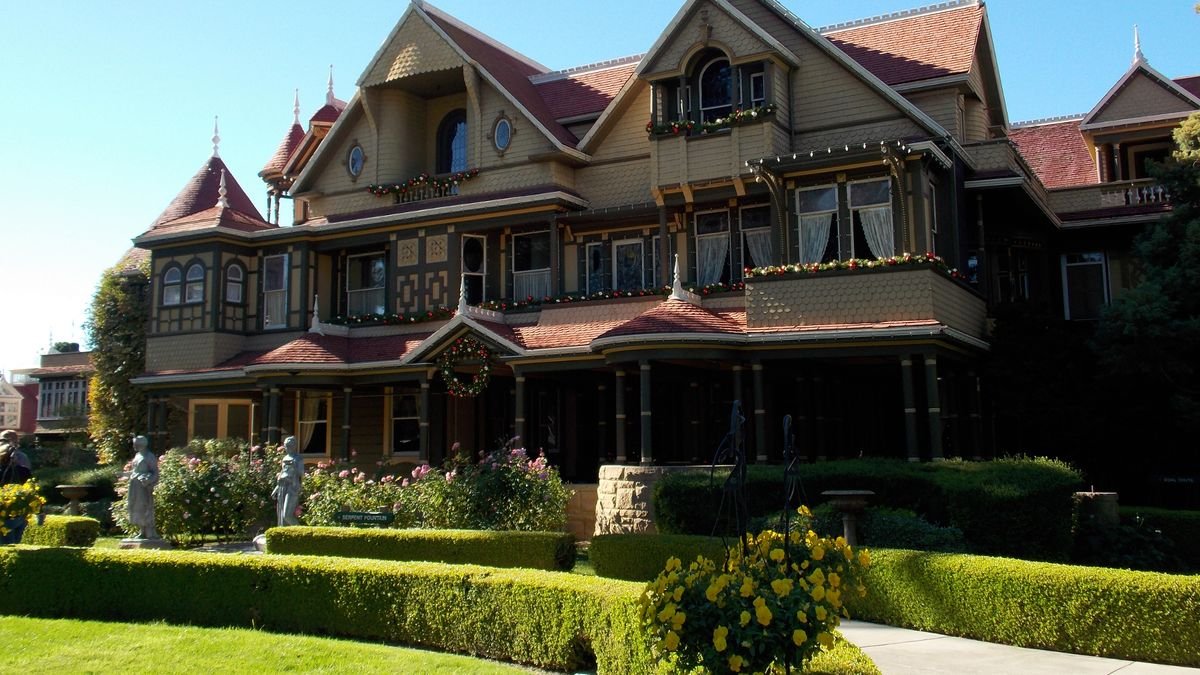

In the heart of a vast estate stands a grand mansion with a dark history rooted in violence and tragedy. Its expansive halls bear witness to the relentless anguish of Sarah Winchester, haunted by the sins of her family legacy.
Sarah, known as the “rifle widow,” inherited the empire of Oliver Winchester, the inventor of the groundbreaking Winchester rifle. This firearm revolutionized warfare with its rapid-fire capabilities, symbolizing destruction without the need for reloading.
The tragic loss of her infant daughter, Annie, in 1866 intensified Sarah’s belief that her family’s misfortunes were punishment for the bloodshed caused by the Winchester rifle. In a desperate attempt to appease the spirits and find solace, she embarked on a frenzied building spree on her San Jose property.
From 1886 until her death in 1922, Sarah employed a dedicated team of carpenters who tirelessly constructed additions to the mansion. What began as a modest eight-room cottage grew into a bewildering labyrinth of over 200 rooms, 10,000 windows, 47 fireplaces, and 2,000 doors, trapdoors, and spy holes.
Sarah’s eccentricity was evident in her designs, often lacking logical purpose and hastily plastered over the next day. Uncovering a hidden chamber in 1975 revealed her forgetfulness, as she unknowingly built over existing rooms.
Driven by guilt and isolation, Sarah Winchester’s enigmatic creation baffled onlookers with its peculiar features. The mansion’s architecture reflected her restless mind, haunted by a troubled conscience and the weight of her family’s violent past.
Descendant Laura Trevelyan shared insights into Sarah’s profound guilt and the origins of the Winchester rifle, a symbol of America’s westward expansion and the conflicts it entailed. The mansion stands as a testament to Sarah’s inner turmoil, a manifestation of her unspoken anguish and desperate attempts to find peace.
In the end, Sarah’s mansion remains a poignant reminder of a woman tormented by her family’s dark legacy and haunted by the ghosts of the past.