

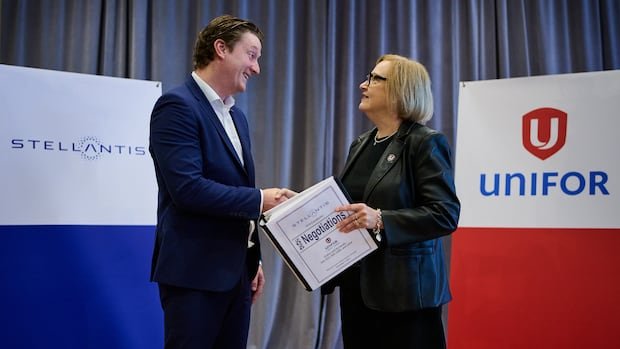

The labor union representing employees at Stellantis has issued a caution to the American automaker regarding the treatment of Canadian workers as contract discussions with Unifor commenced on Tuesday. Unifor, engaged in negotiations with the Detroit Three automakers, utilizes a pattern bargaining strategy to establish terms that can be replicated with other firms.
While Unifor recently ratified fresh collective agreements with Ford Motor Co. and General Motors in Canada, its greatest hurdle lies ahead, according to national president Lana Payne. She acknowledged defying numerous challenges and uncertainties but emphasized that the ongoing negotiations are poised to be exceptionally demanding.
The parties are striving to finalize a new deal by September 11, with job security being a primary concern for the union following layoffs affecting over 2,000 employees at Stellantis’ Brampton, Ontario, assembly plant, which has been inactive since 2023.
Recent notifications indicated Stellantis’ contemplation of shuttering and selling the plant, initially slated for Jeep production before the plan was halted in early 2025. The decision to relocate Jeep Compass production to the U.S. was perceived by the union as a violation of the existing collective agreement, resulting in the indefinite idling of the plant.
Emphasizing the significance of retaining jobs at the Brampton facility, Unifor reiterated its stance against the relocation of Jeep Compass production and urged Stellantis to rectify the situation. Stellantis acknowledged the significance of labor discussions with the union for its future prospects amid evolving trade and regulatory landscapes within the industry.
The ongoing talks are being conducted amidst U.S. tariffs affecting local automakers, with President Donald Trump hinting at potential tariff escalations on Canadian vehicles, auto parts, and steel. Payne stressed the critical nature of safeguarding Canada’s auto sector footprint amidst what she described as an existential crisis for the industry.
Larry Savage, a labor studies expert, highlighted Unifor’s dual engagement in securing vehicle production in Canada with Stellantis and advocating against trade agreements that could jeopardize the domestic auto industry. Unifor recently reported overwhelming member support for new agreements with General Motors, which include wage increases and align with the established pattern bargaining strategy.
The current negotiations hold significant implications for the future of the Canadian auto industry, as both the union and stakeholders navigate challenges posed by tariffs and trade dynamics.