

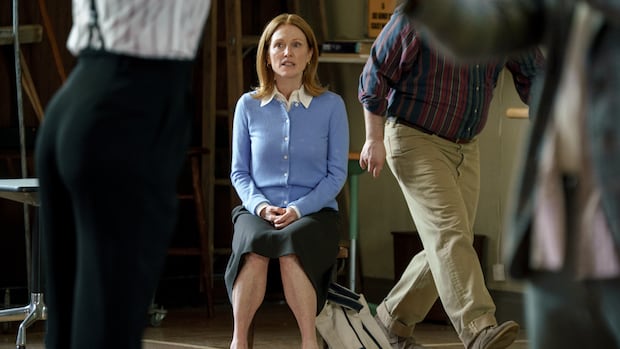

Annually, the film industry presents Oscar contenders: productions crafted to evoke strong emotions from a voting body that often prioritizes artistic flair over genuine substance. Yet, audiences frequently dismiss these films as contrived, disconnected, and overly eager for acclaim.
This scenario might spell trouble for Julianne Moore, the lead in writer-director Jesse Eisenberg’s The Debut — particularly regarding how mainstream viewers will receive her performance, which can only be described as “psychotically brilliant.”
At first glance, the film’s erratic, carnival-like exploration of community theatre carries all the warning signs: a narrative centered on the entertainment industry, an absurdist comedy reminiscent of a New Yorker cartoon, and a protagonist that feels like a blend of Patti LuPone in Evita and Joaquin Phoenix in Joker.
In essence, it appears to be a movie meticulously crafted to secure an Oscar — potentially alienating real viewers who might find it pretentious. However, there are two encouraging aspects for The Debut. Firstly, it is almost guaranteed to win that coveted Oscar. Secondly, it achieves this without compromising authenticity.
Undoubtedly, this film stands out as one of the year’s most exceptional offerings; a brilliant fusion of comedy, horror, and drama that defies categorization. Moreover, it showcases one of the most remarkable and heartwarming performances in recent memory.
The Debut is driven by Moore’s breathtaking and uninhibited portrayal of Mona — a character who initially appears to be exceedingly superficial. As a reserved housewife with two nearly adult children and an emotionally stunted husband, Mona seems to lack the opportunity to cultivate a rich inner life. Instead, she has seemingly spent the past five decades trapped in an overly simplistic, almost fairy-tale existence.
She prepares meals for an ungrateful family in a home that resembles a blend of Martha Stewart and Dr. Seuss’s vision. She partakes in weekly cocktail gatherings with a couple that hardly acknowledges her presence. When she does speak, her voice is a soft, monotone sing-song that practically pleads, “please don’t be upset with me.” Yet, she lacks the confidence to express any strong feelings.
This changes when she opts to audition for a community theatre production of Nosy Neighbors — a fictional musical featuring the eccentric residents of a rundown apartment complex, with Mona cast as the building’s superintendent, Ms. Danielle.
This endeavor serves as a lighthearted satire of plays reminiscent of 7 Stories and The Dining Room — ensemble pieces where wacky characters converge in a single setting, often flooding community theatre schedules. This specificity is refreshing, revealing the perennial struggle to find plays rich in humor for all auditioning.
Eisenberg embodies this experience perfectly. Having been involved in community theatre since the age of six, he has frequently expressed his fondness for the unique individuals encountered in that realm. His 2019 off-Broadway production, Happy Talk, starred Susan Sarandon as a suburban housewife obsessed with her role in a low-budget rendition of South Pacific. Like Mona, she is a character who incessantly discusses her starring performance as if she were Liza Minnelli in Cabaret, though her husband — and by extension, the world — remains oblivious.
The tragically comical plight of a woman yearning for meaning and acknowledgment, which is consistently denied, is a central theme in The Debut. As Mona excitedly discusses her forthcoming role, a key issue arises: her performance is atrocious. Comically atrocious. So bad that it hints at a deeper, more unsettling issue lurking beneath the surface.
-
Apple TV’s Mayday is propaganda — and it rocks
-
Ridley Scott’s The Dog Stars bombs at the box office. Here’s what that tells us about what audiences want
Initially, washed-up director Jerry (Paul Giamatti) believes he can help her improve. The strange developments that follow are best experienced rather than described, although they clearly pay tribute to films focused on delusional, self-absorbed characters such as The King of Comedy, Taxi Driver, and Joker, allowing Moore a vast playground to explore roles that most actors can only dream of.
Throughout, her character strives to uncover truth within fiction, regardless of the cost, resembling a somewhat deranged Uta Hagen — the legendary instructor who inspired countless actors to create and comprehend nearly every aspect of their character’s life. Even if they only had to deliver a single line.
Mona, who begins with an absence of personal identity, takes this approach to a terrifying extreme. The kaleidoscopic and astonishing journey she embarks on is not quite the type to make you laugh until you cry; instead, it might be more about crying until you laugh. Or perhaps experiencing both emotions simultaneously until you lose track of your original feelings.
Absent inner life
In this narrative, Moore embodies a character whose self-worth and inner life have been so stifled that they appear to have withered away entirely. When they finally emerge, it does so with such explosive and breathtaking vitality that it nearly blinds viewers.
This remarkable feat is largely achieved through Eisenberg’s succinct yet confident writing, which feels both meticulously structured and almost improvised; we receive enough glimpses into Mona’s past without being overwhelmed, allowing us to draw our own outrageous conclusions.
The supporting cast also excels; in addition to the poignantly effective two-hander between Giamatti (capturing the tough mentor vibe of The Holdovers) and Moore, the cast and crew of Nosy Neighbors hold their own. Halle Bailey’s role as the lead of the play allows her to showcase her vocal abilities and acting range. Meanwhile, up-and-coming actor Eldar Isgandarov, portraying the meek assistant Piotr, demonstrates his comedic talents that he also exhibits in the equally impressive Club Kid, which is also featured at TIFF.

The Toronto International Film Festival has launched The Market, where filmmakers and global buyers can connect to package and distribute movies, amid a new era of U.S. protectionism. TIFF CEO Cameron Bailey says it’s unique in North America, having both a film festival and a market happening at the same time.
Ultimately, this is Moore’s spotlight — a performance that redefines the clichéd, male-centric archetype of the unhinged, desperate outsider.
The outcome is an unforgettable acting display, a mesmerizing cycle of transformations that will undoubtedly be remembered in the annals of film history. Moreover, it positions her in a uniquely advantageous spot in the Oscar race. Moore’s portrayal in The Debut is a sight to behold and seems impossible to overlook.
Most importantly, it all feels remarkably authentic.