

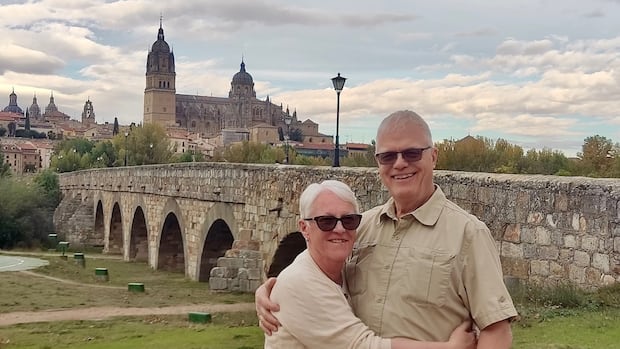

After witnessing a broadcast of a total solar eclipse occurring over Antarctica in 2003, Stephen Bedingfield from Yellowknife made the decision to pursue every eclipse he could find.
This week, he and his wife traveled to Spain to witness his 13th total solar eclipse — 23rd when counting partial eclipses — which is anticipated to last approximately two minutes.
“Picture being able to see the Great Barrier Reef, Niagara Falls, and Mount Everest all at once. That’s the grandeur of a total solar eclipse,” Bedingfield remarked.
“There’s nothing else like it.”
On Wednesday, a total solar eclipse will be observable across Greenland, Iceland, Spain, and northern Russia, as well as a small section of Portugal.
Although the total eclipse won’t be visible in Canada, residents will have the chance to witness a partial solar eclipse, during which the moon will obscure part of the sun.
“This isn’t merely a wonder of the Earth. It’s a marvel of the solar system, showcasing how the sun, moon, and Earth align perfectly to create this phenomenon,” Bedingfield noted.

Bedingfield mentions that during his two decades of following eclipses, he has discovered a community of fellow eclipse enthusiasts. (Submitted by Stephen Bedingfield)
Through his journey as an eclipse chaser, Bedingfield has forged friendships and become part of a community.
“There’s a group of eclipse chasers who attend nearly every eclipse. This adds to the thrill of the experience,” he explained.
“It becomes like a diary, allowing you to travel to various locations around the globe and immerse yourself in different cultures and meet new people.”
He stated that although the eclipse itself may only last a few brief minutes, the environmental changes during that time are significant.
“Temperatures might drop by 15 degrees Celsius in just 15 minutes. Birds will alter their behavior… It’s a completely immersive environmental experience,” he observed.
“It’s an incredible sight to behold.”
Experts advise viewing with eye protection during the eclipse
Here’s when residents in the northern regions can expect to view the partial eclipse in Yellowknife, Whitehorse, and Iqaluit:
- Yellowknife: Peak time is 10:42 a.m. with 28 percent of the sun obscured by the moon.
- Whitehorse: Peak time is 9:27 a.m. with 23 percent of the sun obscured by the moon.
- Iqaluit: Peak time is 1:24 p.m. with 61 percent of the sun obscured by the moon.
Christa Van Laerhoven, the vice president of the Yukon Astronomical Society, emphasizes the importance of using appropriate protection while viewing the eclipse.
This includes certified solar eclipse glasses and at-home alternatives like creating a pinhole projector using an empty box, a white sheet of paper, and some foil.
A leafy tree can also serve as a natural pinhole projector, Van Laerhoven mentioned.
“If you find a way to look at the sun, you will see something resembling Pac-Man: a bright crescent of the sun with a section missing,” she described.
Van Laerhoven pointed out that there is a widespread misconception that the sun is more hazardous during a solar eclipse, but she clarified that looking at the sun is dangerous at any time.
“It’s simply that during a partial eclipse, you might be more inclined to ignore those warning signs and look directly at the sun.”