

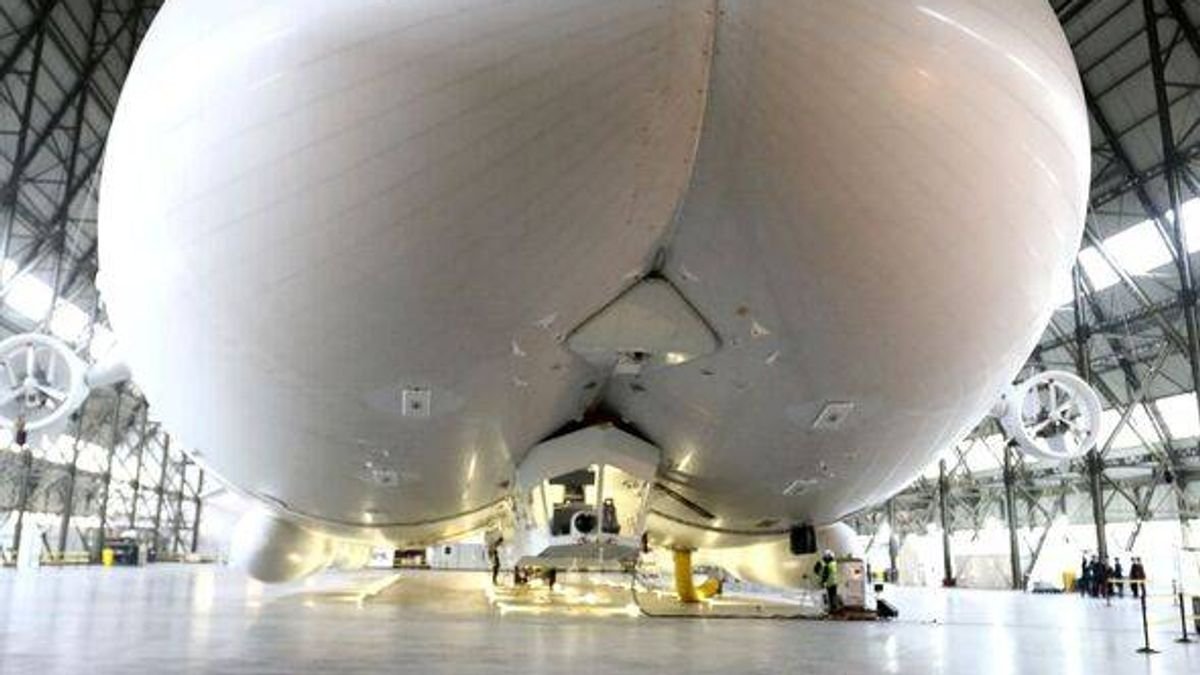

The world’s largest aircraft, playfully named the “flying bum” for its unique design, is capable of landing without needing a traditional runway. Priced at £60 million, this “mega airship” comes equipped with luxurious double bedrooms and an onboard bar, promising to revolutionize air travel.
Manufactured by Hybrid Air Vehicles, the Airlander 10 is poised to introduce a commercial fleet by 2029, boasting a massive 92-meter size that will make it the largest aircraft globally, aiming to transform the way people move around.
The aircraft’s creators envision it accessing locations typically only reachable by helicopters, thanks to its ability to take off and land on various surfaces like grass, gravel, sand, marsh, or water, requiring minimal runway space.
According to George, the aircraft’s flexibility eliminates the need for a paved runway, making it more accessible and cost-effective for operators. Moreover, with a seating capacity for up to 100 passengers, it can facilitate journeys to remote areas previously challenging to reach without a helicopter.
Despite the affectionate moniker “flying bum,” George, who acquired the design post the US military’s disengagement after the Iraq War, expressed no personal sighting of the aircraft, emphasizing its practicality over aesthetics.
The company’s head of marketing, Hannah Cunningham, hinted at a refined version tailored for commercial aviation with a less distinctive rear design. Presently, HAV is focusing on constructing an improved Airlander 10 in Doncaster within the next 12 to 18 months, anticipating a production rate of two dozen units annually starting in 2030 upon Civil Aviation Authority approval.
Promising a more spacious and quieter flying experience compared to conventional airplanes, the Airlander 10 cruises at 3,000 meters, eliminating the need for air pressurization. Despite a maximum speed of 80mph, significantly slower than modern jets like the Boeing Dreamliner, it boasts impressive endurance, capable of covering 4,000 miles in a single trip.
In a bid to enhance environmental sustainability, HAV has partnered with ZeroAvia to equip the Airlander 10 with hydrogen-electric engines, aiming to drastically reduce emissions compared to standard kerosene-powered planes, potentially achieving emission levels as low as 1-2%.
Val Miftakhov from ZeroAvia praised the Airlander’s suitability for their powertrains, foreseeing a new era in air travel due to its range, efficiency, and versatility. Both companies aim to create job opportunities in the aerospace industry, contributing to economic growth across various UK regions.