

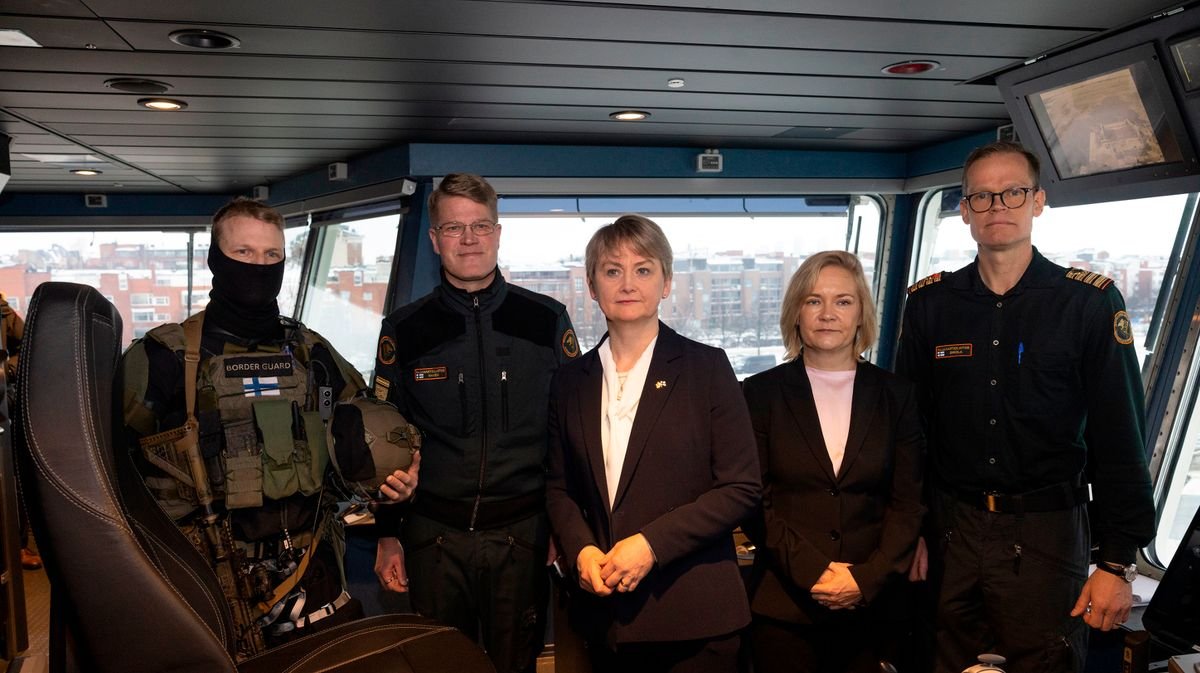

Observing the deck of a Finnish patrol vessel, I witnessed armed personnel descending from a helicopter and launching an assault on the ship.
The masked security forces swiftly advanced to the ship’s control center, vociferously asserting their authority. Fortunately, this was merely a training exercise conducted by the Finnish Border Guard, tasked with safeguarding an 830-mile border along NATO’s eastern periphery in the face of Russian threats. They actively engage with Putin’s covert maritime fleet in the Gulf of Finland and have conducted operations on vessels suspected of tampering with critical undersea cables.
Decked in camouflage attire, the demonstration of seizing a suspected vessel was presented to Foreign Secretary Yvette Cooper during her recent visit to Finland and Norway. The proximity to Russia felt palpable as we boarded the Turva, an offshore patrol ship in Helsinki, overlooking the Gulf of Finland, stretching towards St. Petersburg, the easternmost part of the Baltic Sea.
Given Russia’s close proximity, Finland grapples with Putin’s subversive strategies and hybrid warfare tactics. The significance of the threat posed by the Russian covert fleet to Britain was highlighted during Ms. Cooper’s visit.
During the interview, Ms. Cooper emphasized the imperative of taking action to counter the network of aging oil tankers operating under questionable flags. These vessels not only circumvent Western sanctions, thereby aiding Putin’s unlawful activities in Ukraine, but they are also implicated in sabotaging undersea cables crucial for telecommunications and energy supplies like electricity, oil, and gas.
Reports suggest that the UK is exploring the legality of employing military measures to board these vessels following its involvement in a recent operation with US special forces targeting a tanker linked to Russia. The Foreign Secretary’s trip coincides with escalating tensions in the Arctic region.
The warming seas due to climate change have intensified geopolitical competition as new maritime routes open up and previously inaccessible resources become available due to melting ice. The issue of Greenland’s potential annexation by the US has drawn global attention to the region.
Britain aims to demonstrate its ability to contribute significantly to shaping security measures in the High North alongside NATO allies. However, the potential actions of the US President could disrupt this collaborative effort.