
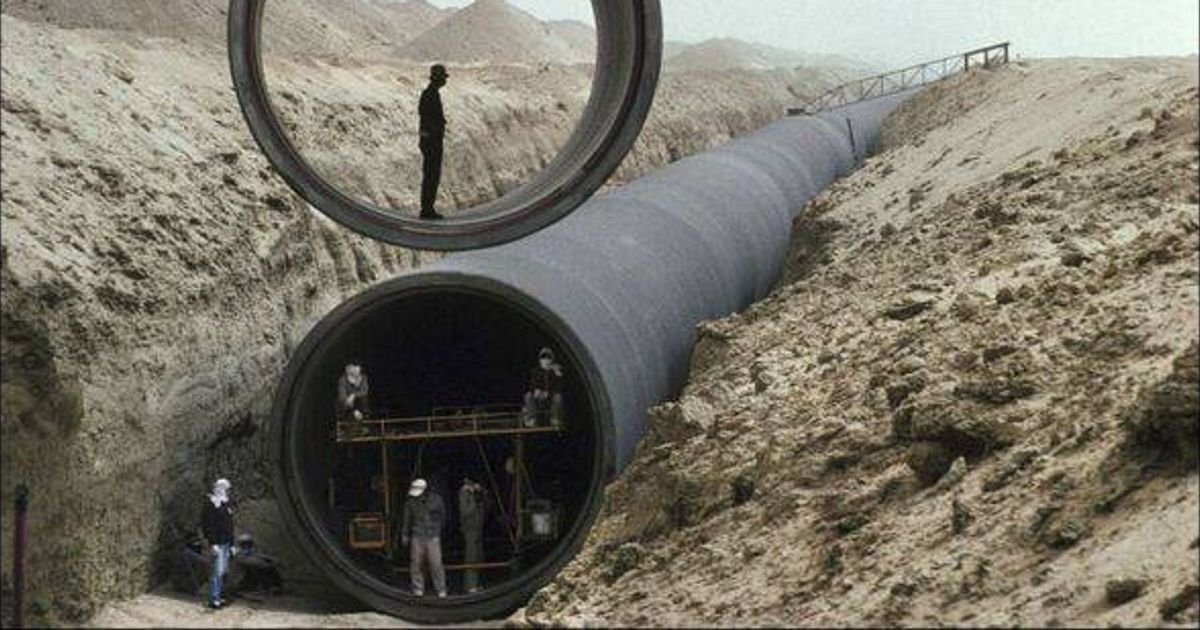

A significant man-made river, believed to be the largest irrigation project globally, is set to undergo further expansion with a new £5.1 billion development phase. The Great Man-Made River (GMMR) is a remarkable engineering achievement in the African desert, aimed at conveying ancient waters to a water-scarce North African country due to its harsh climate.
Covering the entire territory of Libya, the Great Man-Made River Project seeks to access “fossil water” from a vast underground reservoir known as the Nubian Sandstone Aquifer System (NSAS), believed to date back to the previous ice age.
Situated beneath the Sahara Desert and portions of Libya, Egypt, Chad, and Sudan, the NSAS is one of the oldest and largest aquifers on Earth, holding substantial freshwater resources.
The discovery of these aquifers by Libya during oil exploration in 1953 led to the inception of the GMMR project around a decade later in the late 1960s, as reported by Spanish publication Diario AS.
Funded by the late Libyan dictator Muammar Gaddafi, who hailed it as the “eighth wonder of the world,” the GMMR reportedly had a budget of $25 billion (£18.5 billion).
This substantial budget reflects the vast amounts of materials required for the project, with enough materials available to construct “20 Great Pyramids of Giza.”
The Great Man-Made River Authority (GMMRA) estimates the use of approximately five million tonnes of cement, along with steel wires long enough to encircle the earth 280 times.
Divided into five major phases, the GMMRA completed the first phase on August 28, 1991, with operational pipelines spanning 1,750 miles and an additional 2,485 miles in various stages, boasting a daily water capacity of around 1.7 billion gallons.
By December 2025, the fifth phase, nearly three decades later, is nearing completion.
Laura Martin Sanjuan from Diario AS reports that the fifth phase is almost finished, with an estimated cost of $7 billion, expanding coverage to rural and northern areas that are currently not connected.
However, challenges such as the 2011 civil war, reduced public funding, power supply issues, infrastructure damage, and difficulties in importing spare parts have hindered progress.
Designed to supply water to Libya’s densely populated coastal regions, the GMMR provided a viable alternative to the country’s overused coastal aquifers and costly desalination processes, according to Newsweek’s Hugh Cameron.
The GMMRA described the project as “crucial and strategic,” potentially offering the only solution to Libya’s water scarcity issues for drinking, irrigation, and industrial purposes.
Laura also highlighted concerns about the disparity between production costs and consumer pricing, indicating worries about economic sustainability. Additionally, as a non-renewable resource, there are fears that supplies may be depleted by the end of this century.