

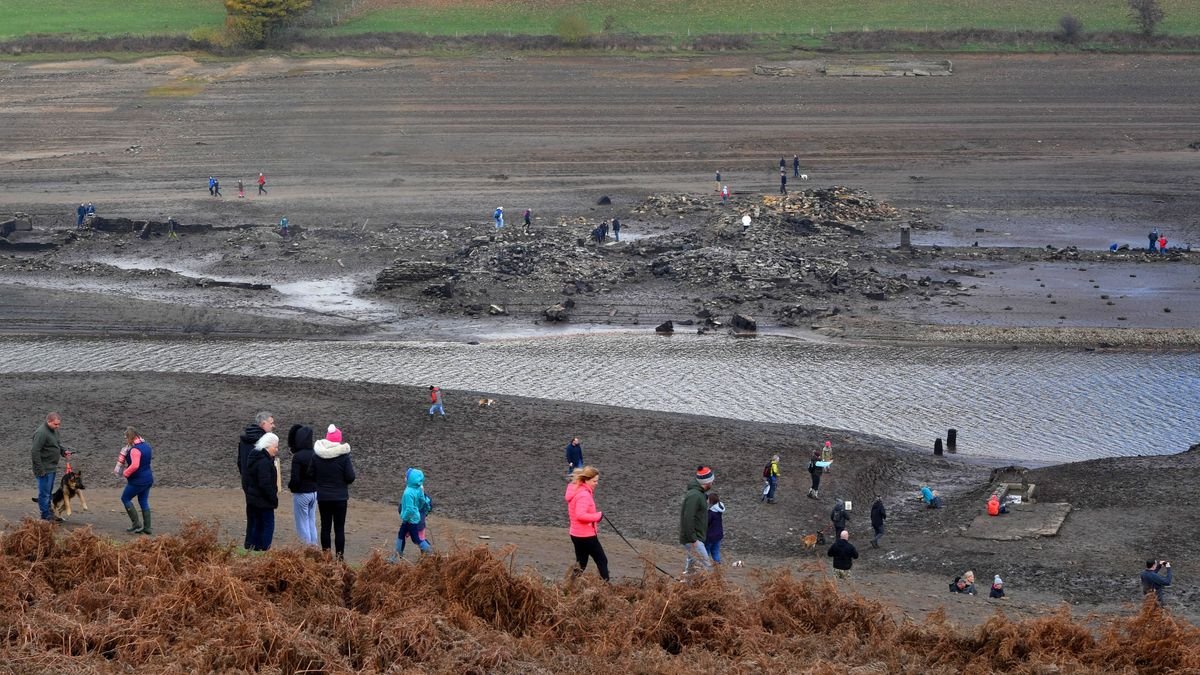

An ancient village that was intentionally flooded over 80 years ago and subsequently disappeared underwater has been periodically resurfacing, unveiling its intriguing history.
Derwent, a once thriving village nestled in Derbyshire’s Peak District, featured charming limestone houses lining picturesque streets that offered stunning vistas of the surrounding countryside where its inhabitants lived.
Despite its small size, Derwent was well-equipped with essential facilities, including a school, church, post office, and a grand manor estate with meticulously maintained gardens and a sizable fishpond, catering to the needs of its residents.
Around 50 people called this serene village home, with sheep grazing on nearby hills and a quaint bridge crossing a river. However, between 1935 and 1943, plans were set in motion to submerge both Derwent and the neighboring Ashopton settlement.
Despite local opposition to the flooding plans, residents were eventually relocated to the Yorkshire Bridge estate, and by 1943, Derwent was transformed into a vast dam to supply water to the growing cities in the English Midlands.
As time passed, the village disappeared beneath the rising waters of the valley, giving way to the creation of Ladybower Reservoir, which now stands in place of the once-vibrant community.
Although Derwent ceased to exist, the reservoir now serves a crucial role, holding an impressive 27,869 mega litres of water to support the water needs of nearby cities like Derby, Sheffield, and Nottingham. It has become a popular destination for hikers and nature enthusiasts, offering spectacular views within the rolling hills of the Peak District.
In a rare occurrence in 2018, following an exceptionally dry summer that significantly lowered the reservoir’s levels, remnants of Derwent resurfaced, revealing parts of the village church, cottage doorways, and walls.
Visitors exploring the exposed ruins discovered a stone fireplace, pathways leading to the old school, cottage remnants, and debris from a small bridge, with some former residents even reporting hearing the church bell tolling, despite its removal before the village was flooded.
In 2019, a 92-year-old former resident, Mabel Bamford, shared her memories of Derwent with the BBC, reminiscing about her school days amidst the construction of Ladybower. She recalled the community spirit and interactions during that time.
The village made a reappearance in 2022 and again in 2025, as low water levels unveiled the remains of the church and other structures. It is speculated that the village may continue to resurface in the future, offering glimpses into its rich history and captivating the imagination of all who visit.